
Blood Cleanup
San Jose, CA
Blood is a regulated biohazard regardless of volume or cause. Whether from an accident, a medical emergency, or a traumatic event, HavenSafe Bio-Restoration coordinates certified technicians across San Jose who remove, decontaminate, and document blood cleanup to California's strictest standards.
HavenSafe Bio-Restoration is an independent referral and coordination service. Cleanup work is performed by licensed, vetted technicians in our professional network.
Why Blood Is Classified as a Regulated Biohazard in California
Under CalOSHA Title 8, Section 5193 — the California Bloodborne Pathogens Standard — human blood is classified as a potentially infectious material (OPIM) regardless of the quantity present or the apparent health of the source. This designation exists because blood can harbor and transmit serious pathogens including:
- Hepatitis B (HBV) — can survive on dry surfaces at room temperature for more than seven days
- Hepatitis C (HCV) — can survive outside the body for up to four days on surfaces
- Human Immunodeficiency Virus (HIV) — survives for shorter periods but remains viable in dried blood for hours
- MRSA and other bacterial pathogens — can be present in blood and bodily fluid mixtures from infected individuals
The regulation makes no distinction based on how the blood got there. An injury in the home, a medical emergency, an accident in a vehicle, an assault, or an unattended death — the same pathogen risk applies, and the same decontamination standards must be met.
California Health and Safety Code §118600 further classifies blood and blood-soaked materials as regulated medical waste, which requires licensed packaging, transportation, and treatment. This isn't a technicality — it's a framework designed to protect future occupants, workers, and the public health infrastructure of Santa Clara County.
Types of Blood Cleanup We Handle in San Jose
Blood exposure occurs across a wide range of situations. Each has unique characteristics that shape the remediation approach.
Medical Emergencies
Heart attacks, strokes, and traumatic injuries managed by SJFD paramedics or Valley Medical Center emergency transport often leave significant blood at the scene. When first responders have finished their work, the cleanup responsibility falls to whoever controls the property. We respond quickly so families can focus on their loved one, not the state of the home.
Violent Crime Scenes
Shootings, stabbings, and assaults generate blood contamination that often extends beyond the visible scene — cast-off patterns on walls, saturation under flooring, tracking through adjacent rooms. See our crime scene cleanup page for a full scope overview. Blood cleanup is always a component of this work.
Unattended Deaths
When a person is not discovered for days or longer, blood and biological fluids migrate extensively through porous surfaces. This type of scene requires specialized testing to map the full contamination footprint before remediation can be properly scoped. See our unattended death cleanup service for more detail.
Industrial and Workplace Accidents
San Jose's mix of manufacturing, logistics, and construction industries produces workplace injury scenes that may involve significant blood exposure. We work with risk managers, HR teams, and facilities staff to coordinate rapid, documented cleanup — often needed before regulatory inspectors arrive or before the facility can safely reopen.
Vehicle Blood Cleanup
Blood in a vehicle — whether from an accident, assault, or medical event — presents unique challenges. Upholstered seating, carpet, and foam padding absorb deeply; door panel and trunk cavities collect runoff. For detailed vehicle decontamination, see our vehicle biohazard cleanup service.
Trauma and Self-Harm Scenes
These are among the most sensitive situations we handle. We approach them with quiet professionalism, full discretion, and complete confidentiality. Our role is to restore the space so that families can focus entirely on what matters most. See our trauma scene cleanup and suicide cleanup pages for more information.
How Blood Moves Through a Structure — and Why Surface Type Matters
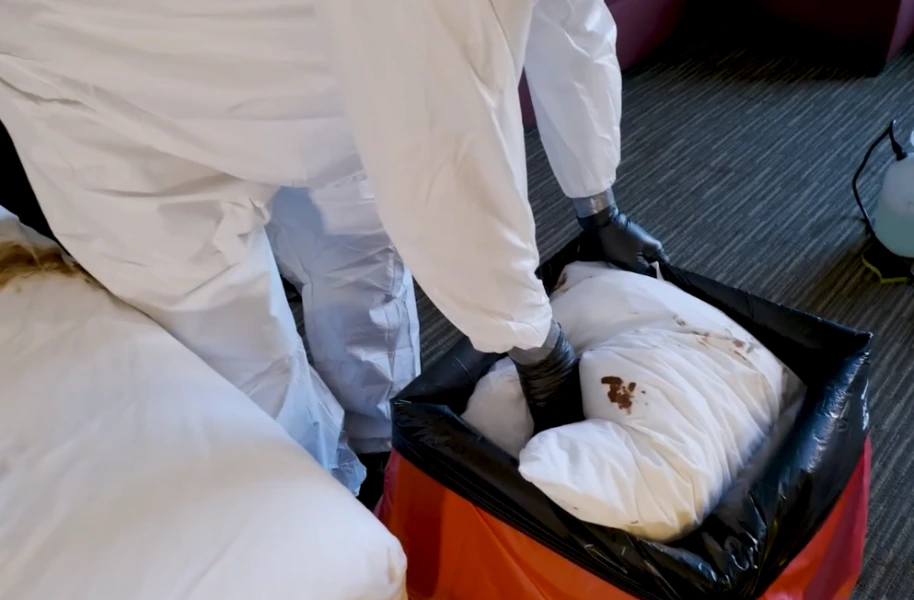
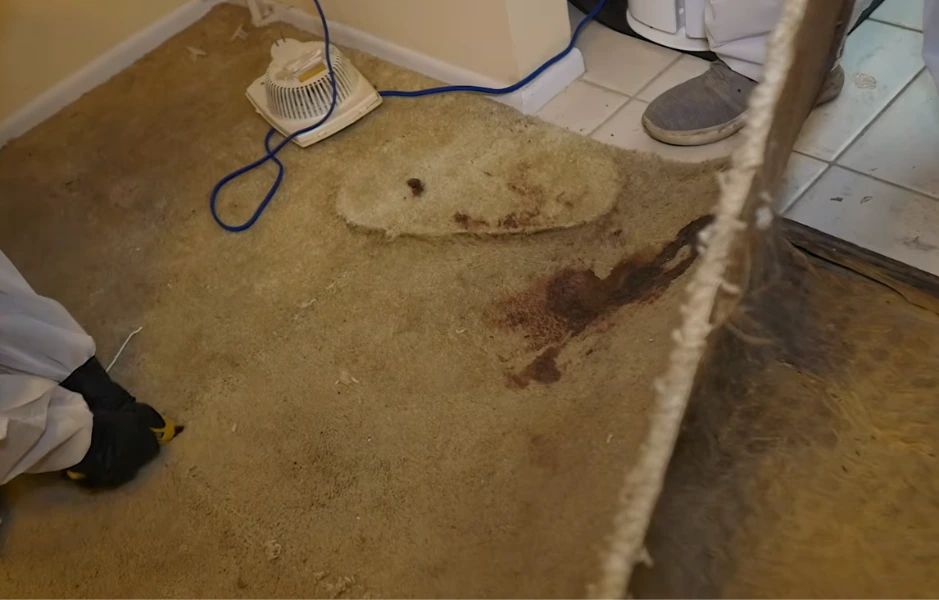
One of the most important things I explain to property owners is that blood does not stay where you see it. Within minutes of a significant exposure, blood follows the path of least resistance — through carpet fibers into padding, through unsealed grout into tile substrate, along wall-floor junctions into baseboards and wall cavities. In San Jose's older housing stock, unsealed hardwood over wooden subfloor is a particularly high-risk combination: blood soaks through the face grain, travels along the wood fibers, and saturates the subfloor below before the surface even appears fully saturated.
Surface-by-Surface Breakdown
Sealed hard surfaces (glazed tile, sealed concrete, sealed stone): Blood sits at the surface and can often be fully decontaminated without material removal, provided cleanup occurs promptly. Grout lines are the exception — grout is porous and may require removal and replacement.
Unsealed hardwood and engineered wood flooring: These are among the most difficult surfaces to decontaminate. Blood penetrates end grain rapidly and can saturate boards that appear clean from above. UV fluorescence testing often reveals a contamination footprint two to three times larger than the visible stain. In many cases, affected boards must be removed.
Carpet and carpet padding: Padding acts as a reservoir. Even light blood contamination at the carpet surface often means the padding beneath is saturated. Both must be removed and disposed of as regulated medical waste. The subfloor below is then tested before new flooring is installed.
Drywall and plaster: Blood wicks into drywall rapidly. In areas near the floor, it may also migrate behind baseboards into the wall cavity. If the wall shows any discoloration or the blood was near a wall-floor junction, we probe and assess for cavity contamination before closing up.
Upholstered furniture: Foam cores and fabric backing absorb extensively. In most cases, heavily contaminated upholstered furniture cannot be fully decontaminated and must be disposed of as regulated waste. We document its condition and disposal for insurance purposes.
Our Blood Cleanup Process
Scene Assessment and Contamination Mapping
Before any work begins, we conduct a thorough assessment using ATP surface testing and UV fluorescence to map the full extent of contamination — including areas not visible to the naked eye. You receive a written scope of work and cost estimate before we start. No surprises.
Containment and Material Removal
We establish a contamination zone, don full PPE per CalOSHA requirements, and systematically remove porous materials — carpet, padding, drywall, affected furniture — that cannot be safely decontaminated in place. All materials are packaged and labeled as regulated medical waste on-site.
Surface Cleaning and EPA-Registered Disinfection
All remaining surfaces — flooring, walls, fixtures, HVAC vents — are cleaned and treated with hospital-grade EPA-registered disinfectants rated to eliminate bloodborne pathogens at the required dwell times. Products and application methods are documented throughout.
Post-Remediation Testing, Waste Disposal, and Documentation
We conduct ATP clearance testing to verify surfaces are within safe thresholds. Regulated medical waste is transported to a California-licensed treatment facility under a signed waste manifest. You receive a complete remediation report with photographs, materials list, lab results, and disposal documentation.
Blood Cleanup in San Jose: What Local Property Owners Should Know
San Jose presents some specific environmental and logistical factors that affect blood cleanup work. Understanding them helps you ask the right questions when evaluating any service provider.
Climate and drying time: San Jose's Mediterranean climate — warm, dry summers and mild winters — accelerates blood drying and the concentration of infectious material at the surface. This is actually a double-edged factor: dried blood on hard surfaces can be more confined, but dried blood on porous surfaces is often harder to fully extract and may have already migrated deeper before drying occurred. Scenes discovered in summer months, particularly in homes without air conditioning, deteriorate faster.
Multi-family housing density: High-density residential areas — the apartment corridors along Story Road in East San Jose, the condo developments throughout Berryessa — mean that blood cleanup in one unit may require coordination with property management and adjacent occupants. We're familiar with this environment and handle these logistics as part of the service.
Older housing stock: The pre-1970s homes that dominate Willow Glen and established neighborhoods like Cambrian Park often have original hardwood floors, plaster walls, and pier-and-beam construction. These materials require more careful assessment than modern construction because blood migrates through them differently and in ways that are harder to detect without testing equipment.
Regulatory compliance: Santa Clara County Environmental Health enforces California's regulated medical waste requirements. Property owners who attempt self-remediation and improperly dispose of blood-soaked materials — in household trash, for example — can face civil penalties. Our waste manifests provide a documented compliance record.
Blood Cleanup FAQs
Is dried blood still a biohazard?
Yes — absolutely. Hepatitis B virus is known to remain viable on dry environmental surfaces for over a week at room temperature. Hepatitis C can survive for days. The fact that blood appears dry or old does not reduce your obligation to treat it as a regulated biohazard. In many cases, dried blood on porous surfaces is harder to fully remediate than fresh blood because it has had more time to penetrate below the surface layer.
Can I clean up blood myself using bleach or disinfectant sprays?
Not safely or legally, in most cases. Consumer bleach solutions do not reliably penetrate porous materials, may not meet EPA kill-claim requirements against HBV and HCV when improperly diluted, and do not address blood that has soaked beneath surface layers. Under CalOSHA Section 5193, any professional handling of blood and bodily fluids requires training, PPE, an exposure control plan, and regulated waste disposal procedures. Beyond the regulatory issue, improper DIY cleanup creates genuine ongoing health risk for you and other occupants.
Which surfaces are hardest to decontaminate after a blood exposure?
Porous and semi-porous materials present the greatest challenge: carpet (and especially the pad beneath it), unsealed hardwood, drywall, grout, acoustic tiles, and foam-core upholstery. These materials absorb blood below the surface layer, making visible cleaning meaningless. Removal and replacement is often the only compliant option. Sealed hard surfaces — tile, sealed concrete, some laminates — are far easier to fully decontaminate, provided cleanup begins promptly and grout lines are addressed.
How is blood waste legally disposed of in California?
Under California Health and Safety Code §118600, blood and blood-soaked materials are classified as regulated medical waste. They must be packaged in UN-certified, puncture-resistant containers, labeled with biohazard markings, manifested, and transported by a licensed medical waste hauler to a licensed treatment facility. We handle every step of this process and provide you with the disposal manifests as part of the job documentation.
How do you know when the cleanup is complete?
We don't rely on visual inspection alone. After remediation, we conduct ATP (adenosine triphosphate) surface testing, which detects organic residue at the molecular level — far below the threshold visible to the human eye. We also use UV fluorescence to check for any missed contamination. The scene is complete only when these tests confirm clearance. You receive the results in writing as part of the final documentation package.
Blood Cleanup in San Jose — We're Available Now
Every hour matters. The faster blood is remediated, the less it penetrates porous surfaces and the lower the overall remediation cost.
HavenSafe Bio-Restoration coordinates cleanup through a network of licensed, vetted remediation professionals. We are an independent referral service.