
Feces & Urine Cleanup
San Jose, CA
Human and animal waste is a serious biohazard — not a job for standard janitorial services. HavenSafe Bio-Restoration coordinates certified technicians across San Jose who handle feces and urine contamination with the pathogen-safe protocols required by CalOSHA, ensuring structural decontamination down to the substrate and permanent odor elimination.
HavenSafe Bio-Restoration is an independent referral and coordination service. Cleanup work is performed by licensed, vetted technicians in our professional network.
Why Feces and Urine Cleanup Requires Professional Biohazard Protocols
Human and animal waste is a Category 3 biohazard — the same classification as blood and other potentially infectious materials (OPIM) under CalOSHA Title 8 CCR §5193. This is not a regulatory technicality. It reflects the genuine pathogen load in feces and urine: hepatitis A, norovirus, E. coli O157:H7, Salmonella, Campylobacter, Clostridium difficile (C. diff), and a range of other bacteria, viruses, and parasites that can cause serious illness through direct contact, airborne exposure, or surface-to-hand-to-mouth transmission.
Standard cleaning services — janitorial companies, general housecleaners, maintenance staff — are not equipped for this work. They lack the personal protective equipment (PPE) required by §5193, the hospital-grade EPA-registered disinfectants capable of neutralizing Category 3 pathogens, the training to assess structural penetration depth, or the regulated disposal protocols required for biological waste under California Health and Safety Code §118600. Using untrained personnel on a contaminated scene does not resolve the hazard — it moves it around and increases exposure risk.
Professional biohazard remediation means removing all contaminated materials, decontaminating structural surfaces to clearance thresholds verified by ATP testing, and eliminating odor at the molecular level. Everything else is incomplete.
Situations That Require Professional Feces & Urine Cleanup
The source and circumstances affect scope, protocols, and urgency — but each scenario below requires professional biohazard remediation.
Sewage Backup and Overflow
Sewer line backups push raw sewage — human waste, bacteria, viruses, and chemicals — into basements, bathrooms, and living areas. San Jose's aging sewer infrastructure, particularly in older neighborhoods, is susceptible to tree root intrusion and pipe failure. Sewage contamination must be treated as a biohazard: everything the water touched must be assessed for salvageability, and all affected surfaces decontaminated.
Human Waste in Residential Settings
Medical incontinence, care situations, unattended death scenes, hoarding environments, and voluntary or involuntary human waste events in residential settings all require professional remediation. Urine and feces saturate flooring materials quickly and penetrate deeply with repeated exposure. Without full material removal and structural decontamination, odor recurrence is certain.
Large Animal Waste Accumulation
Cat, dog, bird, and livestock waste accumulation — particularly from large numbers of animals or long-term confinement — creates concentrated contamination that far exceeds what standard cleaning can address. Cat urine is particularly penetrating and contains uric acid crystals that reform odor molecules on humidity changes. Proper remediation requires material removal and enzyme-based plus disinfectant treatment.
Rodent and Wildlife Infestation
Rodent infestations leave feces and urine throughout nesting areas, wall cavities, attic insulation, and crawl spaces. Rodent droppings can carry hantavirus — a potentially fatal respiratory illness transmitted by inhaling aerosolized dried droppings. Raccoon feces may contain Baylisascaris procyonis (raccoon roundworm), which remains infective for years. These hazards require specialized handling protocols that go beyond ordinary pest control cleanup.
Rental Properties and Tenant Situations
California landlords who discover significant waste contamination in a vacated rental unit face both a health hazard and a legal obligation. Under California Civil Code, the unit must be restored to habitable condition before re-rental. Standard cleaning crews cannot perform this work safely or effectively. We document the contamination scope thoroughly for insurance and security deposit claims.
Commercial and Public Facility Incidents
Waste contamination events in commercial kitchens, healthcare facilities, schools, public restrooms, and office buildings require rapid professional response to minimize downtime and ensure the facility is safe for reoccupancy. We work efficiently and discreetly, with no unmarked vehicles and professional conduct that respects the sensitivity of the situation.
How Deep Does Contamination Penetrate — and What Must Be Removed
The most common mistake in amateur cleanup is treating only the surface. Here is the actual penetration profile by material type.
| Surface / Material | Urine Penetration | Feces Penetration | Typical Outcome |
|---|---|---|---|
| Carpet (synthetic fiber) | Full saturation within hours | Surface + fiber penetration | Removal required |
| Carpet padding / underlayment | Full saturation; holds uric acid crystals | Penetrates readily | Always removed |
| Hardwood / engineered wood flooring | Penetrates along grain and seams | Surface; seeps between boards | Often removed; test before decision |
| Wood subfloor | Deep grain penetration with time | Moderate penetration | Often requires removal or sealing |
| Sealed concrete | Surface; pooling near cracks | Surface | Decontamination; seal inspection |
| Unsealed / porous concrete | Absorbs readily; deep penetration | Surface absorption | Decontamination + sealant; may require grinding |
| Drywall (lower sections) | Wicks upward via capillary action | Surface splash | Lower sections often removed |
| Insulation (attic / crawlspace) | Full saturation from rodents | Heavy rodent/wildlife contamination | Removal and replacement required |
We use moisture meters and ATP bioluminescence testing to map contamination depth before quoting the work. This avoids both under-scoping (leaving contamination behind that causes odor recurrence) and over-scoping (removing materials that do not need replacement).
Our Feces & Urine Cleanup Process
Scene Assessment and Contamination Mapping
Before any work begins, we assess the full extent of contamination — visual inspection, moisture meter readings across all affected surfaces, and ATP testing where initial indicators suggest deeper penetration. We identify every affected material and determine what can be decontaminated in place versus what must be removed. You receive a written scope and cost estimate before work is authorized.
PPE Deployment and Area Containment
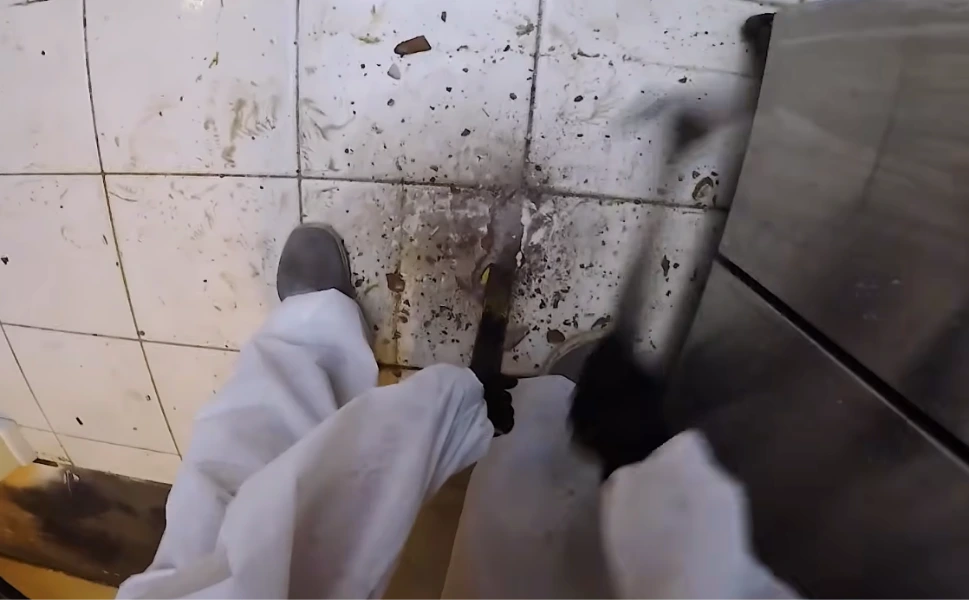
All technicians working the scene don full CalOSHA §5193-compliant PPE: Tyvek suits, N95 or respirator-grade respiratory protection, chemical-resistant gloves, and eye protection. We establish containment where needed to prevent cross-contamination to unaffected areas, particularly important in multi-room events or multi-unit buildings.
Contaminated Material Removal and Regulated Disposal
All contaminated porous materials — carpet, padding, flooring, drywall, insulation — are removed and packaged as regulated medical waste under California Health and Safety Code §118600. Materials are transported and disposed of through licensed medical waste treatment facilities. We document every material removed with a disposal manifest.
Structural Surface Decontamination
All exposed structural surfaces — subfloor, concrete, framing, wall cavities — are HEPA-vacuumed, cleaned, and treated with hospital-grade EPA-registered disinfectants in compliance with CalOSHA §5193. For urine-saturated wood, we apply enzyme-based pre-treatment to break down uric acid crystals before disinfection. Post-treatment ATP testing confirms surfaces have reached clearance thresholds.
Molecular Odor Treatment
After full source removal and surface decontamination, we treat residual odor compounds with ozone generation, hydroxyl radical generation, or thermal fogging depending on the size of the affected area and the nature of the odor compounds involved. This step addresses any remaining volatile compounds at the molecular level, producing permanent odor elimination rather than temporary masking.
Clearance Verification and Documentation
Final ATP testing confirms the treated area has reached safe surface pathogen levels. We provide a written clearance report documenting the scope of work, materials removed, treatment protocols applied, and test results. This documentation supports insurance claims, property transactions, and regulatory compliance as needed.
Feces and Urine Cleanup in San Jose — What We Encounter in This Market
San Jose presents a specific set of conditions that drive demand for professional waste contamination cleanup. The city's large unhoused population — concentrated in encampments along Coyote Creek, Guadalupe River, and throughout the downtown core — means that property owners, parks management, and transit authorities deal with human waste contamination events regularly. These are not simple cleaning jobs: they require the same pathogen-safe protocols as any other biohazard scene.
San Jose's older rental housing stock, particularly in Berryessa and East San Jose, sees a higher incidence of waste contamination from tenant situations, aging plumbing systems, and sewer line failures. Landlords and property managers in these areas routinely need professional biohazard cleanup between tenancies — both to restore habitability and to meet their legal obligations under California Civil Code.
The city's significant senior population — particularly in Willow Glen, Almaden Valley, and Evergreen — contributes to demand from families managing in-home care situations, unattended death scenes, and long-term care environments where incontinence has caused significant structural contamination over time.
San Jose's climate also matters. With warm, dry summers, uric acid crystallizes rapidly in flooring materials and intensifies when humidity rises in fall and winter — a cycle that makes odor recurrence in inadequately treated spaces particularly pronounced here compared to cooler, more humid markets.
Why the Odor Keeps Coming Back — and How We Stop It Permanently
Feces and urine odor that persists or returns after cleaning is the single most common complaint we receive about previous attempts at amateur or non-specialist cleanup. The science behind this is straightforward — and so is the solution.
Human and animal urine contains urea, creatinine, uric acid, ammonia, and a range of volatile organic compounds. The initial ammonia odor fades as it off-gasses. What remains are uric acid crystals embedded in porous materials. When humidity rises — from weather, cleaning, or reoccupation — these crystals reactivate and release odor compounds. This is why a room can appear odor-free for weeks and then smell again after rain or mopping. No commercial deodorizer, air freshener, ozone machine, or masking agent addresses uric acid crystals. Only removing the contaminated material or treating the substrate with enzyme-based products that break the crystals down solves the problem.
Feces odor involves a different set of compounds — skatole, indole, hydrogen sulfide, methyl mercaptans — that are even more difficult to eliminate from porous materials without full removal. Surface disinfection does not remove these compounds from deep within wood grain or concrete.
Our protocol addresses odor permanently by: (1) removing all contaminated materials so the source is gone, (2) treating remaining structural surfaces with enzyme-based products and disinfectants that break down organic compounds, and (3) applying ozone or hydroxyl treatment only after the source is removed — to address any remaining traces. This sequence is the only approach that produces lasting results.
Feces & Urine Cleanup FAQs
Is feces and urine cleanup covered by homeowners insurance?
Coverage depends on your policy and the cause of contamination. Sewage backup is often covered by sewer backup endorsements. Biohazard remediation for human waste contamination may be covered under your policy's other-structures or personal property provisions. Landlord policies often cover damage caused by tenants. We provide thorough documentation — written assessment, photographs, disposal manifests — to support any claim. We recommend contacting your insurer before authorizing work so we can coordinate with any adjuster if needed.
Can waste contamination spread through HVAC systems?
Yes. Ammonia and volatile organic compounds from urine and feces can enter HVAC ductwork and distribute odor and airborne particles throughout a building. In cases involving significant volume or long duration, HVAC duct inspection and cleaning may be part of the remediation scope. We assess this during the initial walkthrough and include it when warranted.
What pathogens are found in human feces and urine?
Human feces can contain hepatitis A, norovirus, rotavirus, E. coli, Salmonella, Campylobacter, and Clostridium difficile (C. diff). These are classified under CalOSHA §5193 as potentially infectious materials requiring professional handling. Animal feces carry a different pathogen profile — rodent waste may harbor hantavirus, raccoon feces may contain Baylisascaris procyonis (raccoon roundworm). All are addressed with hospital-grade EPA-registered disinfectants in our remediation protocol.
How deep does feces or urine contamination penetrate into flooring?
The depth depends on volume, duration, and surface porosity. Urine can fully saturate carpet and padding within hours and penetrate wood subfloor with repeated exposure. With long-duration contamination, it may reach soil below a crawlspace. We use moisture meters and ATP testing to map contamination depth before quoting the work, so the scope accurately reflects what must be removed.
Why does the odor come back after cleaning?
Odor recurrence means the source was not fully eliminated. Urine contains uric acid crystals that embed in porous materials and reactivate when humidity rises — causing odor to return after weeks or months of apparent absence. Surface treatment or masking agents do not address these crystals. The only permanent solution is removing contaminated materials and treating the structural substrate with enzyme-based products that break down the uric acid before applying disinfectants and molecular odor treatment.
Safe, Thorough, Permanent
Feces and urine cleanup done correctly — with certified protocols, proper disposal, and guaranteed odor elimination. Call us any hour of the day or night.
HavenSafe Bio-Restoration coordinates cleanup through a network of licensed, vetted remediation professionals. We are an independent referral service.